How to Spot Fake Saffron: 5 At-Home Tests
The quick answer: Real saffron releases its golden-red color slowly into warm water over several minutes, smells of honey and dried hay, and the threads stay whole and trumpet-shaped. Fakes (dyed corn silk, safflower, or marigold) bleed color instantly, smell of nothing or of chemicals, and crumble. Below are five tests you can do at home in minutes.
Test 1: The warm water test
Drop a few threads into warm (not boiling) water and wait. Real saffron tints the water a gradual golden-amber over 10 to 15 minutes, and the threads keep their red color. Fake saffron dumps color in seconds, often a flat orange or red, and the threads lose their color entirely.
Test 2: The smell test
Genuine saffron has a distinctive aroma: warm honey, dried hay, and a faint floral note. If your saffron smells sweet like candy, or smells of nothing at all, treat it as suspect.
Test 3: The look of the thread
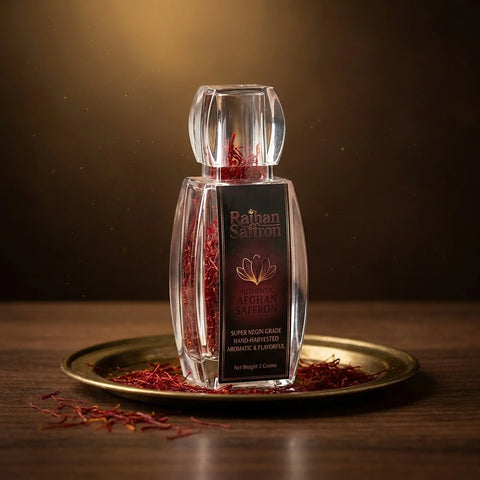
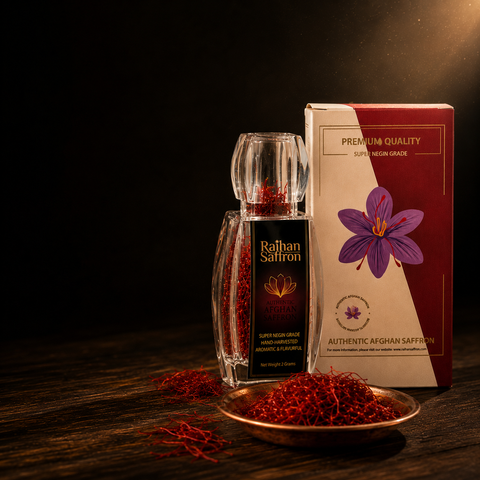
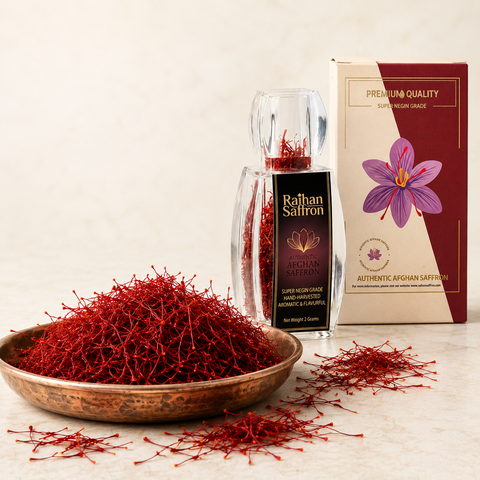
Real saffron threads are deep crimson and flare into a trumpet shape at one end. Uniform, perfectly straight, or bright orange strands are red flags. All-red Super Negin is the longest, reddest grade, with no yellow style attached.
Test 4: The taste
Saffron tastes earthy and slightly bitter, never sweet. Sweetness usually means the threads were coated or dyed.
Test 5: The price reality
Saffron is the most labor-intensive spice on earth; roughly 150,000 flowers make one kilogram, all hand-picked. Saffron sold far below market price is almost always cut or fake.
What real saffron looks like
- Deep, even crimson with trumpet-shaped ends
- Slow color release in warm water
- Honey-and-hay aroma
- Graded and lab-tested (see ISO 3632 grades explained)
Every Raihan bottle is all-red Super Negin from the 2025 Herat harvest, hand-packed in Lynn, Massachusetts. Start with a 2 g bottle or browse all sizes.
Buy the real thing
Whole all-red threads, harvest-dated, with the lab report published.
Shop the harvest Saffron calculatorISO 3632 Category I · harvest-dated · free U.S. shipping over $49
The harvest bottles
Lab-graded Super Negin — pick your size
Frequently asked questions
How can you tell if saffron is real?
Put a few threads in warm water. Real saffron releases its gold slowly over 10 to 15 minutes and the threads stay red. Dyed fakes bleed color almost instantly and the threads turn pale.
Does real saffron turn water red?
No. Real saffron turns water golden yellow. If the water turns red or orange-red, the threads were dyed — that is one of the clearest signs of a fake.
What is fake saffron usually made from?
Most commonly safflower petals, corn silk, dyed coconut fibre, or shredded paper coloured with food dye. Powdered “saffron” is the easiest to adulterate, which is why whole threads are safer.
Does real saffron taste sweet?
No. Real saffron smells sweet — honey, hay and a hint of rose — but tastes slightly bitter. If threads taste noticeably sweet, they were likely soaked in something sugary to add weight.
What does the baking soda test show?
Stir a pinch into water with a little baking soda. Real saffron turns the water yellow. Fake or dyed saffron typically turns it red or reddish-orange.