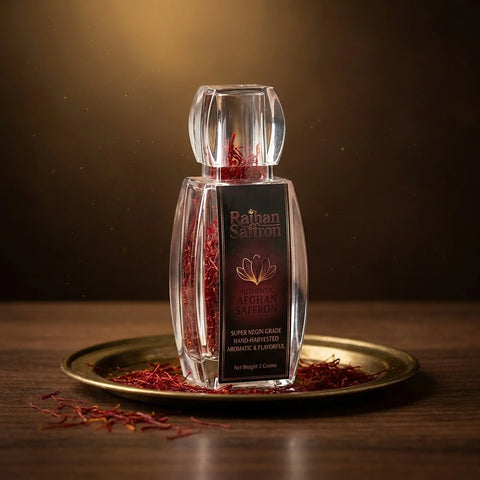
Saffron crocuses are planted in summer, bloom in October–November for only about two to three weeks, and must be picked by hand before sunrise the same day they open. The three red stigmas inside each flower are then separated by hand and dried over low heat the same day. From flower to finished bottle, every step is manual.
Watch: our fields and our harvest in Herat
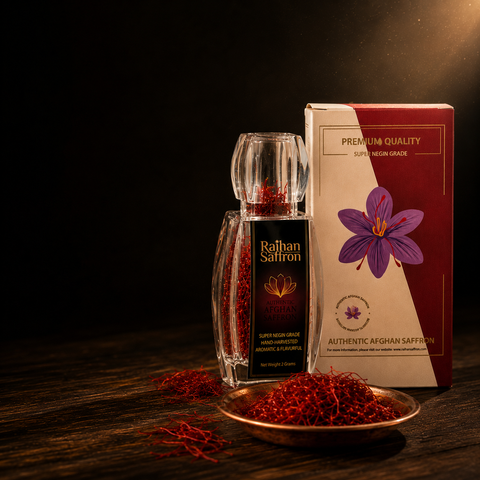
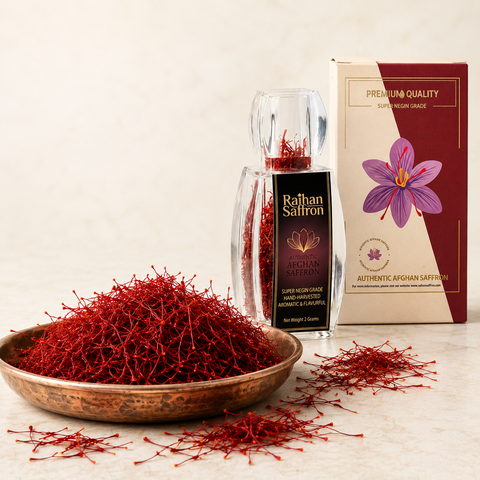
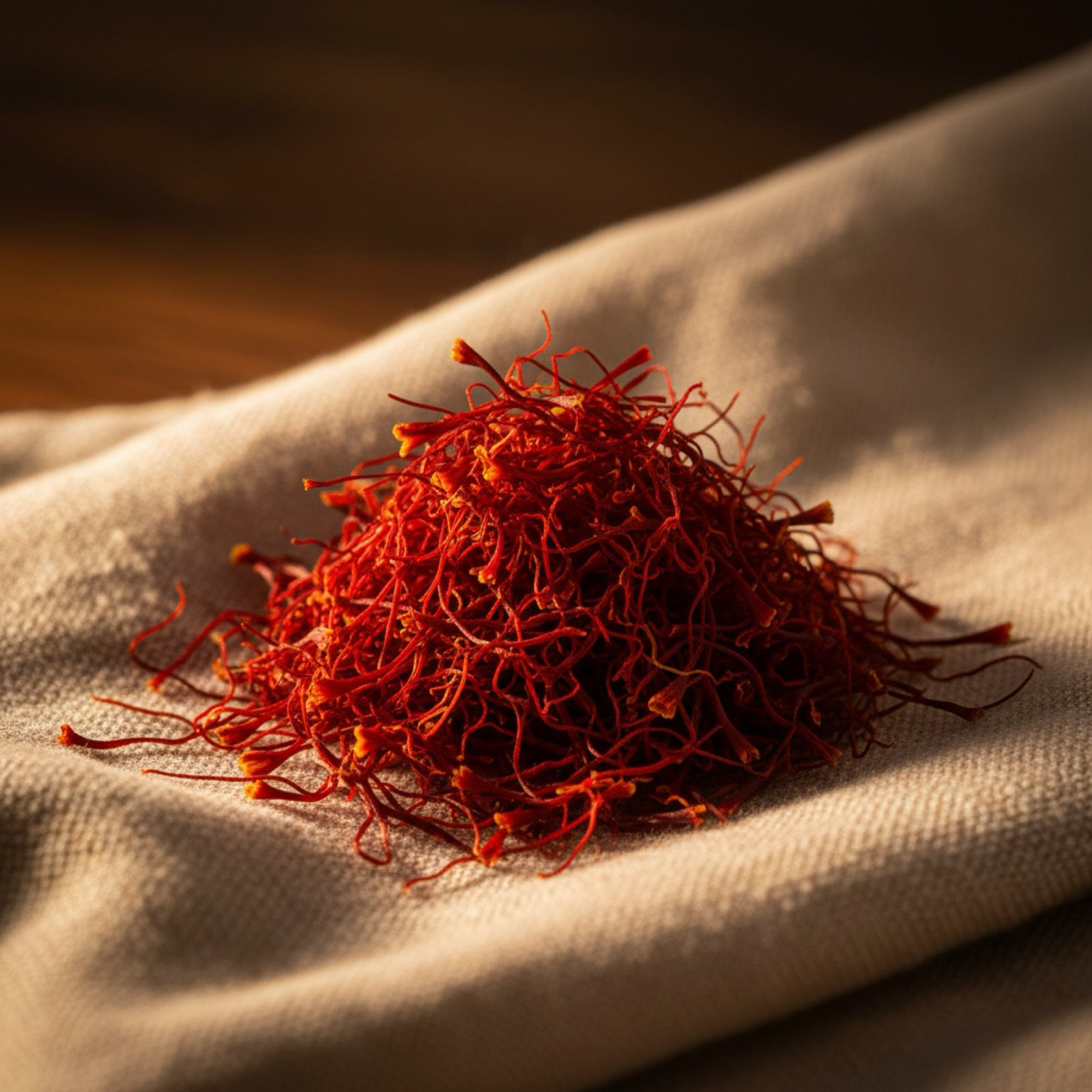
Most saffron articles use stock photos. This is our actual supply chain: the first film is our crocus field in Herat before the autumn bloom; the second is freshly separated Super Negin threads from that same harvest, beside the box they ship in.
Planting (June–August)
Corms (the underground bulbs) are planted in well-drained soil, 4–6 inches deep. Fields are rotated every 4–7 years. The crocus needs cold winters and dry summers — exactly Herat's climate.
Editor's note
The care taken at the drying trays applies in your kitchen too: heat and light are what strip saffron of its aroma. Keep threads in their airtight bottle, away from the stove and the window, and they will hold their character until the next harvest comes around.
Bloom (October–November)
Flowers open just before sunrise and close again by afternoon. The window is roughly 14–21 days per year.
Picking (dawn, by hand)
Pickers walk the rows before sunrise. Each flower is picked at the base while the petals are still closed. The pace is about 8,000–10,000 flowers per picker per day. One acre yields roughly 8–10 pounds of dried saffron over a typical season — sometimes less.
Stripping / depuration (same day)
Within hours of picking, workers separate the three red stigmas from each flower. This is the most labor-intensive step. A skilled worker can strip about 30,000 flowers a day — yielding only about 200 g of dried saffron.
Drying
Threads are dried gently — traditionally on woven trays over low heat, or in modern temperature-controlled cabinets. The goal is to evaporate moisture without burning the volatile aroma compounds (especially safranal). Drying takes 30–60 minutes.
Sorting and grading
Threads are sorted by cut (Super Negin, Negin, Sargol, Pushal, Bunch), checked for color, smell, and uniformity, and packed in airtight containers away from light.

Why this matters for what's in your bottle
Every step is a quality fork. Harvest at the wrong hour, dry too hot, store too long, and the threads lose color and aroma fast. The Raihan supply chain is short by design: family farm → cleaned and dried → flown to Lynn → packed → shipped.
Quick answers about the saffron harvest
How many flowers does it take to make saffron?
About 150 hand-picked flowers yield one gram of dried saffron — roughly 150,000 flowers per pound. Each flower carries only three red stigmas, so a 2 g bottle represents around 300 flowers picked, stripped, and dried by hand in a single day.
When is saffron harvested?
Once a year, in October and November. The crocus blooms for only two to three weeks, and each flower must be picked at dawn the same day it opens, before the sun wilts the petals and degrades the stigmas.
In what country is 90% of the world's saffron grown?
Iran grows roughly 85–90% of the world's saffron. Neighboring Afghanistan — especially Herat province, which shares the same high-desert climate — produces a far smaller crop that has repeatedly won international quality awards. Every Raihan bottle begins in those Herat fields.
Why is saffron so expensive?
Because no step can be mechanized: one picker gathers 8,000–10,000 flowers a day, and a skilled worker strips 30,000 flowers for about 200 g of finished spice. See our 2026 saffron price guide for what a fair per-gram price looks like.
Is saffron still picked by hand today?
Yes — everywhere in the world. The flowers open at ankle height, bruise at a touch, and hide their three stigmas inside closed petals. No machine can harvest them without destroying the very threads that make saffron valuable.
Continue reading